Kim H. Veltman
The Kim Veltman Foundation is promoting his works by making them available to a larger audience online. Kim H. Veltman is Scientific Director of VMMI (Virtual Maastricht McLuhan Institute); author and consultant on implications of new media for scholarship, culture and society.
His research began with two historical topics: the history of perspective, and Leonardo da Vinci. During the 1980s, he began studying new models of culture which go beyond the limits of euro-centric and asian-centric approaches. Since 2004, this theme has become central to his studies, focussed on cosmology and alphabets. This led to lectures, several articles and a major book on Alphabets of Life.
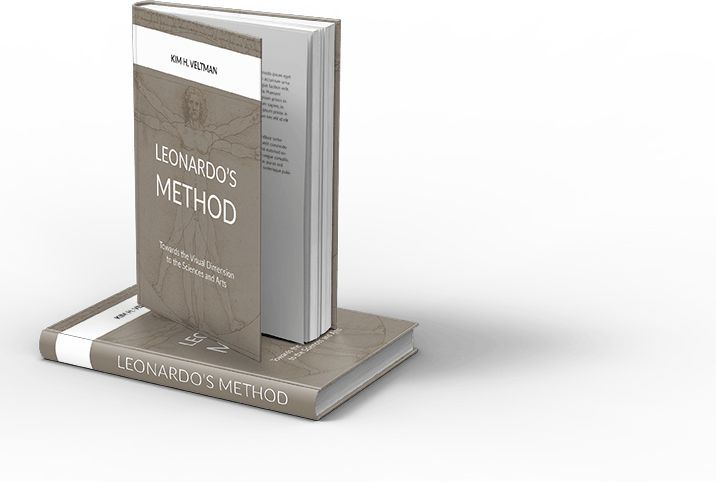
Read moreThe final version of this book was written in ten days, but the work on which it is based covers nearly 20 years. In 1973–1974, Dr. Kenneth D. Keele, M.D., F.R.C.P. and the author reconstructed some of Leonardo's descriptions of perspective in order to determine whether these had an experimental basis. It was found that they did. The possibility that they had simply been thought experiments was excluded because some of his claims were so unlikely that they had to be tested in order to make sense.
The evidence of Leonardo's notebooks confirmed that he was widely read and had many contacts. His extant treatises revealed much more structure than has generally been assumed. Examination of his entire extant corpus brought to light another unexpected feature: for all their universality, the notebooks are focussed on a surprisingly small number of basic themes — among these his studies of transformational geometry and a mechanical approach to nature, using as a point of departure his concept of four powers (weight, force, motion and percussion). These studies were guided by a distinct method of listing variables systematically and playing with them experimentally.
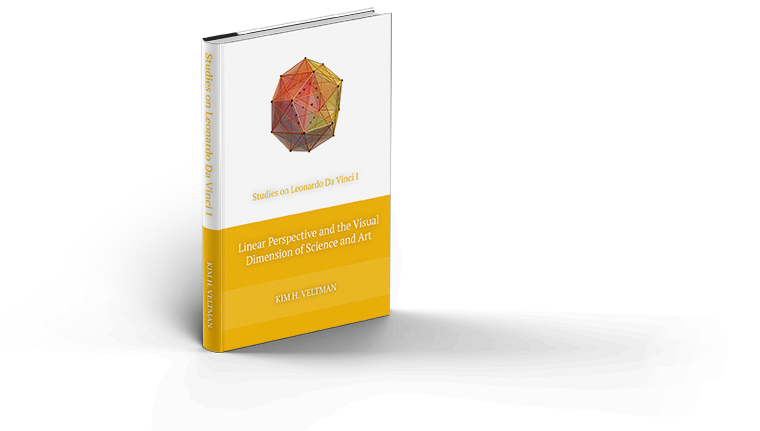
This is the first comprehensive treatment of Leonardo da Vinci's writings on linear perspective. The author outlines the ancient and medieval background and assesses the contributions of 15th-century authors such as Alberti, Filarete, Francesco di Giorgio Martini, Piero della Francesca and Luca Pacioli.
With photographs of models and three-dimensional diagrams he is able to explain Leonardo's often cryptic two-dimensional sketches. Through experimental reconstructions carried out with the distinguished Leonardo scholar Dr. Kenneth D. Keele, he establishes that da Vinci was the first to demonstrate quantitatively the laws of linear perspective. With the patience of a detective he traces the steps that led from simple surveying experiences to a complex method of spatial demonstration.
A basic argument of the book is that perspective is not simply a means of copying reality but rather a method serving to build bridges between geometry and nature. Three aspects of this process are described, namely, how Leonardo uses perspective to make three-dimensional models of: (1) the regular solids and other geometrical figures, (2) organic objects in Nature, and (3) abstract concepts of physics such as heat and force.
Perspective, the author concludes, transformed Leonardo's approach and changed the direction of Renaissance art and science. Some of its wider philosophical and cultural implications he explores in an epilogue.
This study was written between 1979 and 1984. Whereas the first volume offers a survey of Leonardo's philosophy of science in general, this second volume provides a detailed examination of the scope and limits of Leonardo's scientific method with respect to a specific branch of physics.
A survey is given of the optical tradition from Euclid to Kepler. It is noted that in Antiquity and throughout the Middle Ages the term "image" was treated equivocally such that mental images and physical images were not distinguished. It is claimed that Leonardo's optical studies introduce a basic change in approach. He adopts traditional verbal similes, takes them literally and translates them into visual problems which can then be experimentally verified. As a result, problems of optics which had been subjects for philosophical debate become questions of physics.
Leonardo's concept of percussion is studied. It is shown how this fits into Leonardo's system of the four powers by means of which he set out to explain all physical phenomena.
An audio recording from 1970. Press play to listen.
Kim H. Veltman's full bibliography and writings are maintained on his personal site.
Visit kimveltman.nl